BEGIN:VCALENDAR
VERSION:2.0
CALSCALE:GREGORIAN
METHOD:PUBLISH
PRODID://CTSL//210028
BEGIN:VEVENT
DTSTAMP:20260410T205534
VTIMEZONE:America/Los_Angeles
DTSTART:20260417T190000Z
DTEND:20260417T200000Z
UID:210028
SUMMARY:Corrective Feedback that is 'Good Enough' (TOP-IG)
LOCATION:CATESOL Zoom
DESCRIPTION:Corrective Feedback that is 'Good Enough' (TOP-IG)\n\n04/17/26 12:00 PM PST\n - 04/17/26 01:00 PM PST\Description:\n\n\nThis presentation reports a study of corrective feedback (CF) using computer-assisted pronunciation training. The study looked at how accurate feedback needed to be to promote pronunciation improvement. In the study, 30 native speakers of Chinese completed a pretest, a computer-based training session to produce nine sound contrasts in English, and a post test. The study manipulated feedback accuracy using a modified “Wizard of Oz” protocol where a phonetically-trained human listener in a separate room provided CF on the trainees’ productions, while the trainees thought that the computer-based system provided the CF. The computer system presented nine sound contrasts: three with 100% accuracy, three with 66% accuracy (with one of three human responses changed randomly), and three with 33% accuracy (with two of three human feedback responses changed). Pre and post test productions were rated for accuracy by native speakers of English. Pronunciation accuracy was not significantly different for CF with 100% or 66% accuracy, but both resulted in greater improvement than feedback with 33% accuracy. An important implication for L2 pronunciation training software is that machine feedback (indeed, any feedback) can be beneficial when it is ‘good enough’ (i.e., not 100% accurate). \n \n\nPresenter\n\nJohn M. Levis is Distinguished Professor of Applied Linguistics and Technology at Iowa State University. He is founding editor of the Journal of Second Language Pronunciation and the founder of the Pronunciation in Second Language Learning and Teaching Conference. He is the author of Intelligibility, Oral Communication and the Teaching of Pronunciation and co-author of Teaching Pronunciation with Confidence: A Resource for ESL/EFL Teachers. He is also co-editor of Second Language Pronunciation: Bridging the Gap Between Research and Practice, The Handbook of Second Language Pronunciation, and Social Dynamics in Second Language Accent.\n\nHosts\n\nTeaching of Pronunciation Interest Group (TOP-IG)\nMarsha Chan and Patryk Mrozek. Co-coordinators\nDonna Brinton, Assistant Coordinator\n\nModerator\n\nMarsha Chan\n\nDate and Time \n\nFriday, April 17, 2026, 12:00-1:00 PM California Time \n\nCost\n\nMembers: Free\nNon-members: $5.00\n\n#catesoltop\n\Location:\nCATESOL Zoom\n\n,
X-ALT-DESC;FMTTYPE=text/html:Corrective Feedback that is 'Good Enough' (TOP-IG)
04/17/26 12:00 PM PST - 04/17/26 01:00 PM PST
Description:
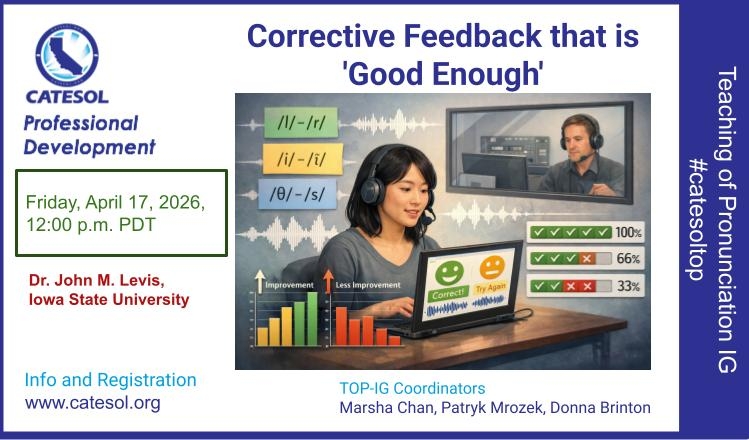
This presentation reports a study of corrective feedback (CF) using computer-assisted pronunciation training. The study looked at how accurate feedback needed to be to promote pronunciation improvement. In the study, 30 native speakers of Chinese completed a pretest, a computer-based training session to produce nine sound contrasts in English, and a post test. The study manipulated feedback accuracy using a modified “Wizard of Oz” protocol where a phonetically-trained human listener in a separate room provided CF on the trainees’ productions, while the trainees thought that the computer-based system provided the CF. The computer system presented nine sound contrasts: three with 100% accuracy, three with 66% accuracy (with one of three human responses changed randomly), and three with 33% accuracy (with two of three human feedback responses changed). Pre and post test productions were rated for accuracy by native speakers of English. Pronunciation accuracy was not significantly different for CF with 100% or 66% accuracy, but both resulted in greater improvement than feedback with 33% accuracy. An important implication for L2 pronunciation training software is that machine feedback (indeed, any feedback) can be beneficial when it is ‘good enough’ (i.e., not 100% accurate).
Presenter
John M. Levis is Distinguished Professor of Applied Linguistics and Technology at Iowa State University. He is founding editor of the Journal of Second Language Pronunciation and the founder of the Pronunciation in Second Language Learning and Teaching Conference. He is the author of Intelligibility, Oral Communication and the Teaching of Pronunciation and co-author of Teaching Pronunciation with Confidence: A Resource for ESL/EFL Teachers. He is also co-editor of Second Language Pronunciation: Bridging the Gap Between Research and Practice, The Handbook of Second Language Pronunciation, and Social Dynamics in Second Language Accent.
Hosts
Teaching of Pronunciation Interest Group (TOP-IG)
Marsha Chan and Patryk Mrozek. Co-coordinators
Donna Brinton, Assistant Coordinator
Moderator
Marsha Chan
Date and Time
Friday, April 17, 2026, 12:00-1:00 PM California Time
Cost
Members: Free
Non-members: $5.00
#catesoltop
Location:
CATESOL Zoom
,
PRIORITY:3
TRANSP:TRANSPARENT
BEGIN:VALARM
TRIGGER:-PT5M
ACTION:DISPLAY
DESCRIPTION:Reminder
END:VALARM
END:VEVENT
END:VCALENDAR