This is the summary of NAA's member-only roundtable. During this gathering, Sarah Floyd, NAA’s Outreach & Engagement Manager, shared the NAA team’s analysis related to the use of AI, including assessments for meaningful applications, guiding principles to evaluate outcomes, practical recommendations for thoughtful, values-aligned adoption, and curated resources for your consideration as you tackle these questions in your own organization.
Briefs are professionally developed and formatted summaries of webinars and symposia, including key points, practical tips, Q & A, references, and presenter bios. These packages also include unlimited access to the program recordings.
This webinar highlights a Case Study from the California Channel Islands. With a goal of advancing collaborative conservation, we spearheaded a data sharing system for the Channel Islands off the coast of California and Baja California, Mexico. By sharing data and standardizing collection practices, we are moving toward more effective conservation across these unique and vulnerable islands. Cal-IBIS provides a blueprint for information sharing in other conservation regions.
PRESENTER: Heather Schneider, Ph.D., Senior Rare Plant Conservation Scientist, Santa Barbara Botanic Garden
Webinar briefs are professionally developed and formatted summaries of webinar presentations, including key points, practical tips, Q & A, references, and presenter bios. This brief includes access to the webinar recording. Briefs are formatted to be useful in both a printed and digital format.
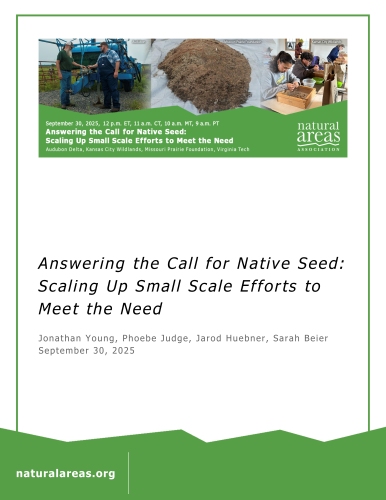
Stewards of natural areas in the eastern U.S. have been finding creative ways to address their needs for locally sourced, genetically appropriate seed to be used in the restoration of high biodiversity and ecologically significant landscapes (natural areas). These efforts involve critically important partnerships between state agency and NGO natural areas conservation programs and local farmers, seed companies, academic institutions, partner NGOs, state wildlife agencies and state seed associations. Each state’s program is unique in their approach, funding source, challenges and successes. This webinar will feature a panel formed by practitioners from programs in Missouri, Virginia, Arkansas, Kansas City and Minnesota.
PRESENTERS:
Sarah Beier, Kansas City Wildlands
Jerod Heubner, Missouri Prairie Foundation
Phoebe Judge, Virginia Tech
Jonathan Young, Audubon Delta
Webinar briefs are professionally developed and formatted summaries of webinar presentations, including key points, practical tips, Q & A, references, and presenter bios. Briefs are formatted to be useful in both a printed and digital format. This package also includes unlimited access to the webinar recording.
The Occidental Arts & Ecology Center (OAEC) seeks to “change the rules” with a focus on utilizing low-tech process-based restoration (LTPBR) techniques, such as “gully stuffing”, to restore hydrologic and ecologic processes to riverine systems. This webinar will introduce the OAEC’s Fuels to Flows Campaign, which advances climate-smart nature-based restoration solutions at the nexus of fire and water. This approach advocates for the reintegration of fire and “fuel” load management with the “flows” of the carbon, water and life cycles. Created in the west as a collaborative approach to the critical need to restore water to the landscape and improve forest resilience to fire, Brock Dolman will share ample project case studies to demonstrate how the Fuels to Flows principles can become a framework for creative low-tech, cost-effective, hands-on solutions to a wide vari
PRESENTER: Brock Dolman, LLC Intentional Community & Occidental Arts and Ecology Center (OAEC)
Webinar briefs are professionally developed and formatted summaries of webinar presentations, including key points, practical tips, Q & A, references, and presenter bios. Briefs are formatted to be useful in both a printed and digital format. This brief includes access to the webinar recording.
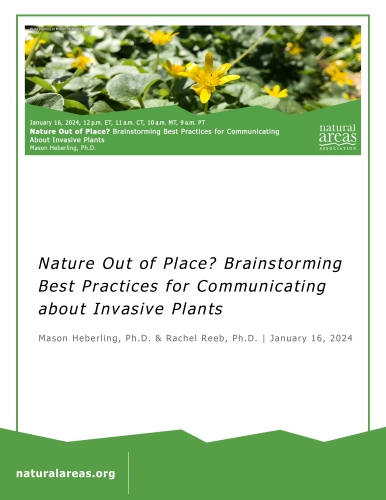
Species invasions are ranked among the topic global drivers of change to biodiversity and ecosystem services, with big economic costs. Communicating about introduced species and their impacts in ways that engage and empower audiences can be challenging but is necessary to enable informed decision making. Public trust can be weakened if scientists, educators, or natural resource practitioners focus on value-laden, subjective language at the expense of objective facts when describing the impacts of invasive plants. Similarly, communication about introduced species can unintentionally lead to xenophobic attitudes toward nature and culture alike. These aspects of invasive species messaging have been largely overlooked, especially in museums, nature centers, and other institutions where public-facing messages have potential to influence local culture and opinions. This webinar will present an overview of a recent, ongoing project at Carnegie Museum of Natural History on invasive plants and seek participant feedback and discussion on best practices for effectively and inclusively communicating about invasive plants to diverse audiences. This webinar will collaboratively explore the direction of this project, which will later culminate with outreach materials and an exhibit on plant invasion.
PRESENTER: Mason Heberling, Ph.D., Associate Curator of Botany Carnegie Museum of Natural History
Webinar briefs are professionally developed and formatted summaries of webinar presentations, including key points, practical tips, Q & A, references, and presenter bios. Briefs are formatted to be useful in both a printed and digital format. This brief includes access to the webinar recording.
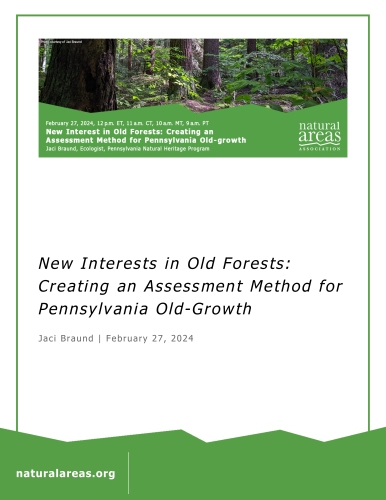
Old-growth forests have recently gained nationwide attention for their significant carbon storage capacity and biodiversity; however, many basic questions remain on their identification and ecology in Pennsylvania. In this webinar, Ecologist Jaci Braund will discuss how the Pennsylvania Natural Heritage Program is using new methods to identify what differentiates old-growth forests in Pennsylvania based on regional literature and field observations. Goals for this project include utilizing these characteristics to drive best management practices for both old-growth and mature forests, and determining habitat needs for old-growth species.
PRESENTER: Jaci Braund Ecologist, Pennsylvania Natural Heritage Program
Webinar briefs are professionally developed and formatted summaries of webinar presentations, including key points, practical tips, Q & A, references, and presenter bios. This brief includes access to the webinar recording. Briefs are formatted to be useful in both a printed and digital format.