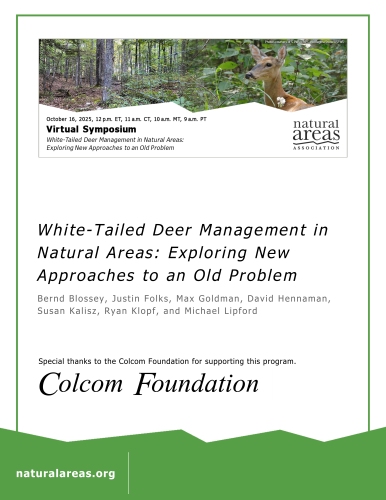
This 3-hour virtual symposium convenes leading scientists, land management practitioners, and wildlife professionals, who have spent decades focused on high white-tailed deer populations as a leading cause of reductions in local biodiversity and a major factor in the prevention of forest regeneration. Sessions will highlight recent evidence-based research underscoring the need for deer management in natural areas. Participants will also learn about a scalable, multi-pronged approach being piloted in Virginia, where the Department of Conservation and Recreation’s (VADCR) Division of Wildlife Resources and Natural Heritage Program are collaborating with public and private partners to reduce herd size and shift deer behavior utilizing implementation and monitoring protocols; a model that could be replicated in other states. The symposium concludes with a facilitated panel discussion so that participants may engage with researchers and agency practitioners to ask questions and further explore the specific considerations that allowed VADCR to move forward with this collaborative initiative. Learn from on-the-ground practitioners about emerging research and initiatives that seek a new approach to an on-going land management challenge.
PRESENTERS:
Bernd Blossey, Ph.D., Cornell University
Susan Kalisz, Ph.D., University of Tennessee - Knoxville
Ryan Klopf, Ph.D., Virginia Natural Heritage Program
Virginia Department of Wildlife
Justin Folks, Deer Project Leader
Max Goldman, Statewide Access Coordinator
David Hennaman, Recruit, Retain, and Reactivate Coordinator
Michael Lipford, Division Director
Professionally Formatted Brief - A concise, actionable summary for land management practitioners that includes key points, practical tips, and highlights from Q & A.
Briefs are formatted to be useful in both a printed and digital format.
Unlimited Access to the Event Recording
JOIN US
Support the people who manage our natural areas and protect biodiversity in perpetuity.