| Date | Event |
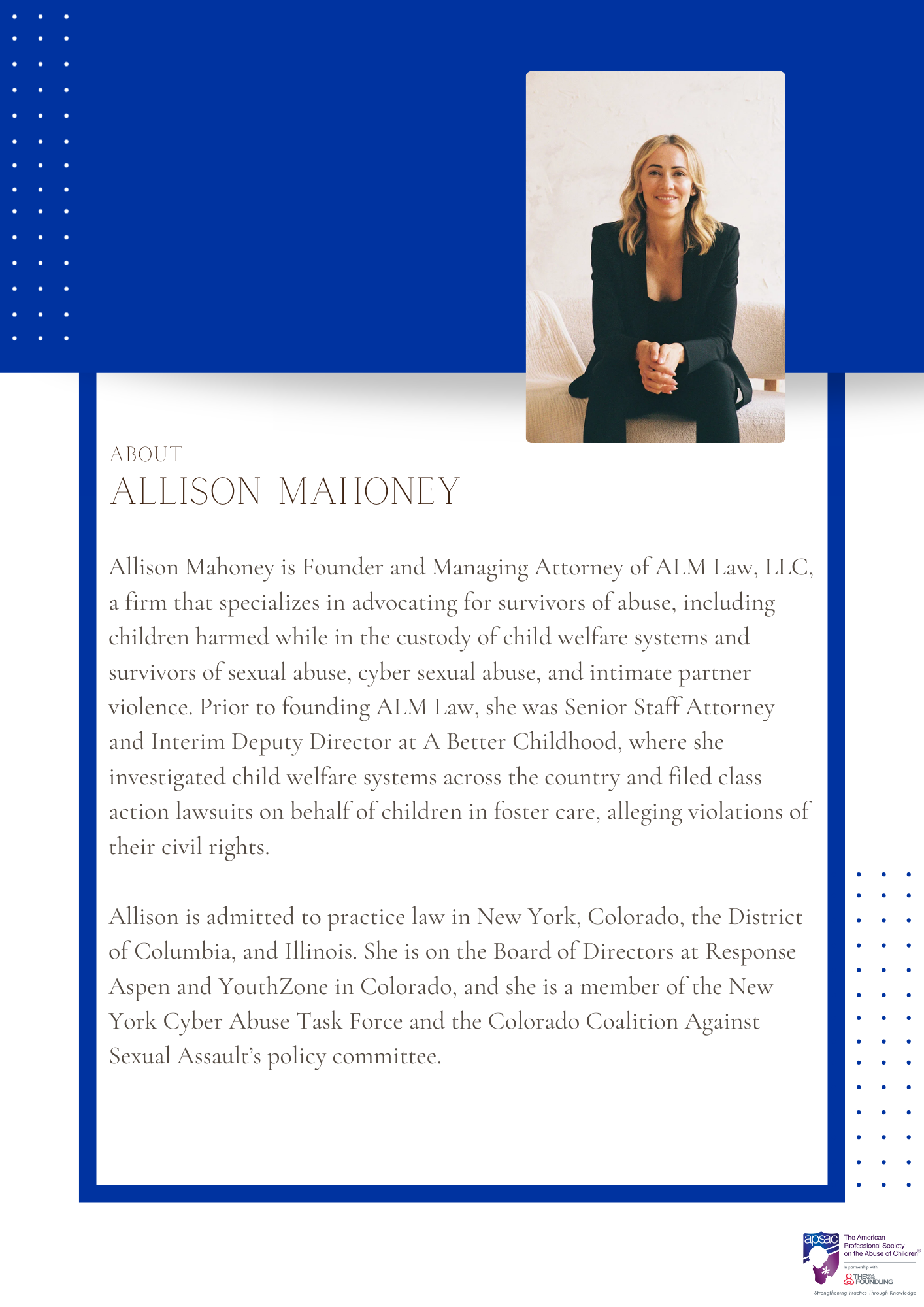
| 1/14/2026 -1/14/2026 | 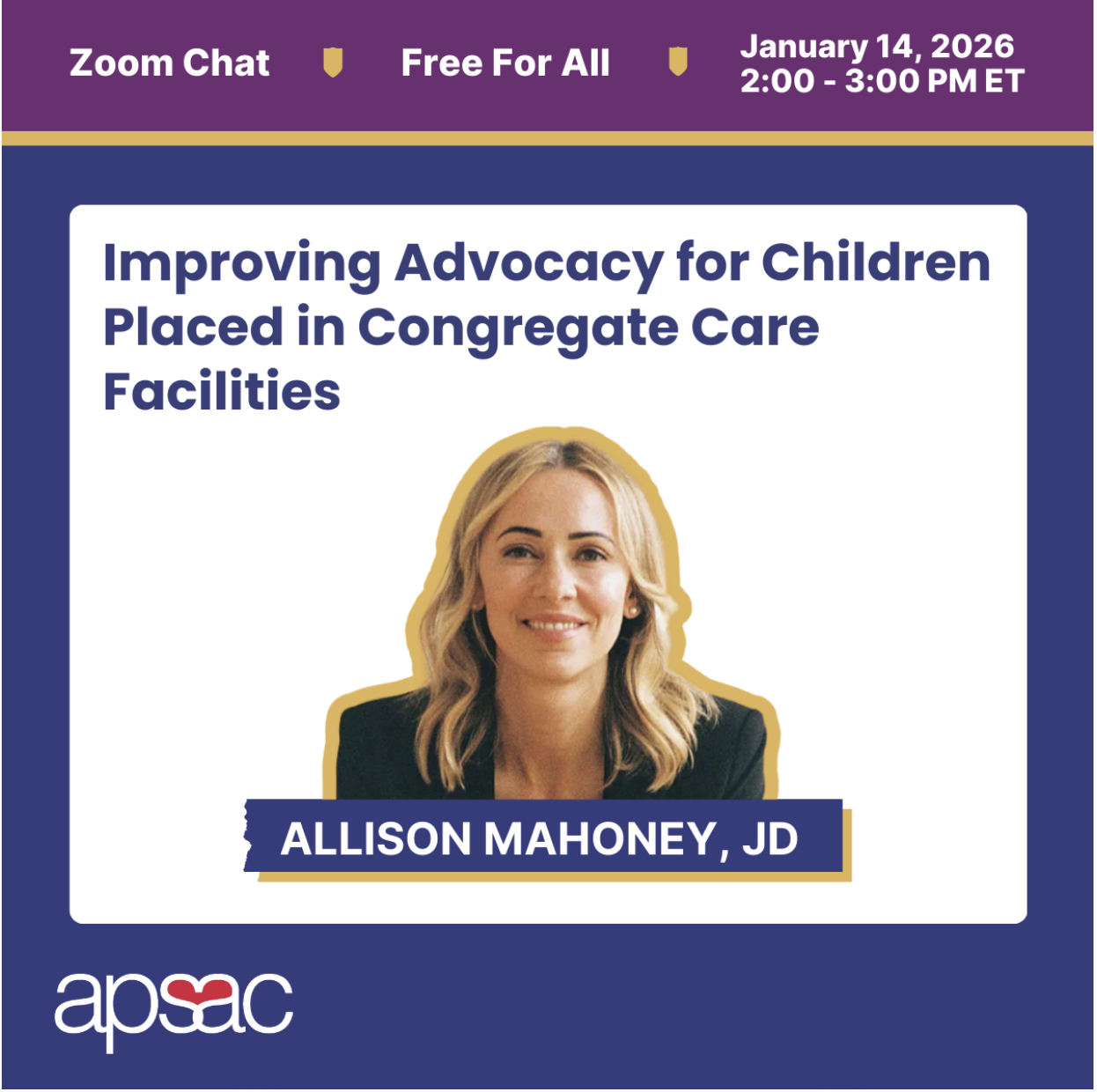 Description: This webinar examines the need to reform how child welfare advocates and attorneys support youth placed in congregate care facilities—and why the practice of sending children to out-of-state facilities must end. Drawing on recent investigations and federal reports exposing widespread abuse, neglect, and systemic failures in both for-profit and non-profit congregate care settings, the session will explore the profound harms children experience, including physical and sexual abuse, overuse of restraints, lack of treatment, and social isolation. Participants will learn practical strategies to advocate for clients, including how to identify red flags at facilities, conduct meaningful check-ins with youth, document and report abuse, and pursue available remedies such as civil litigation, systemic reform, and legislative advocacy. By the end of the webinar, advocates and those working with children will have concrete tools to challenge harmful practices, prevent unnecessary institutionalization, and safeguard the rights and well-being of children in care. Presenter: Allison Mahoney, JD |
| 1/15/2026 -12/17/2026 | The APSAC Prevention Series returns in 2026 will be held on the 3rd Thursday of the month. This is a monthly opportunity to learn from leading experts in child maltreatment prevention and child well-being offered to expand your toolkit with the strategies and resources needed to implement effective prevention practices and improve outcomes for children and families. Member Registration: Free Non-Member Registration: $149 APSAC MEMBERSHIP INFORMATION 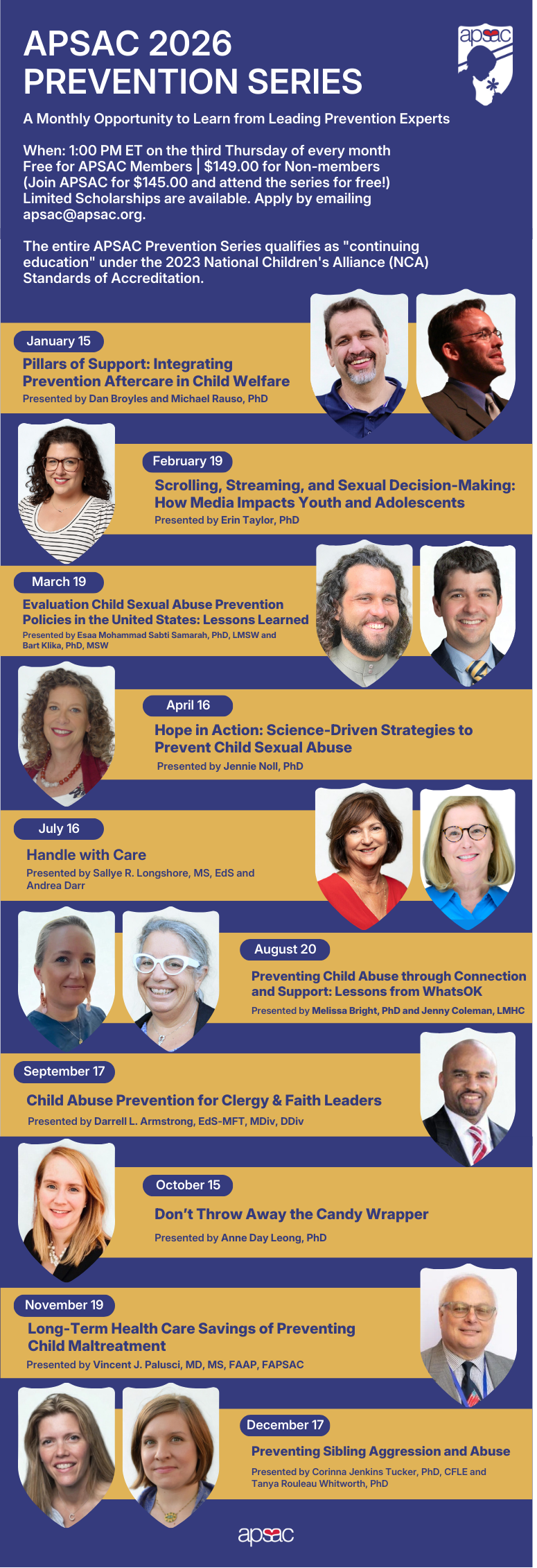 January 15, 2026: presented by Pastor Dan Broyles and Dr. Michael Rauso February 19, 2026: presented by Erin Taylor, PhD March 19, 2026: presented by Esaa Mohammad Samarah & Bart Klika, PhD April 16, 2026: presented by Jennie Noll, PhD May and June: Summer Break July 16, 2026: presented by Sallye R. Longshore, MS, EdS & Andrea Darr August 20, 2026: presented by Mellissa Bright, PhD & Jenny Coleman, LMHC November 19, 2026: presented by Vincent J. Palusci, MD, MS, FAAP, FAPSAC September 17: presented by Darrell L. Armstrong, EdS-MFT, MDiv, DDiv, FAPSAC October 15: presented by Anne Day Leong, PhD December 17, 2026: presented by Corinna Jenkins Tucker, PhD, CFLE & Tanya Rouleau Whitworth, PhD |
| 1/22/2026 -1/22/2026 | 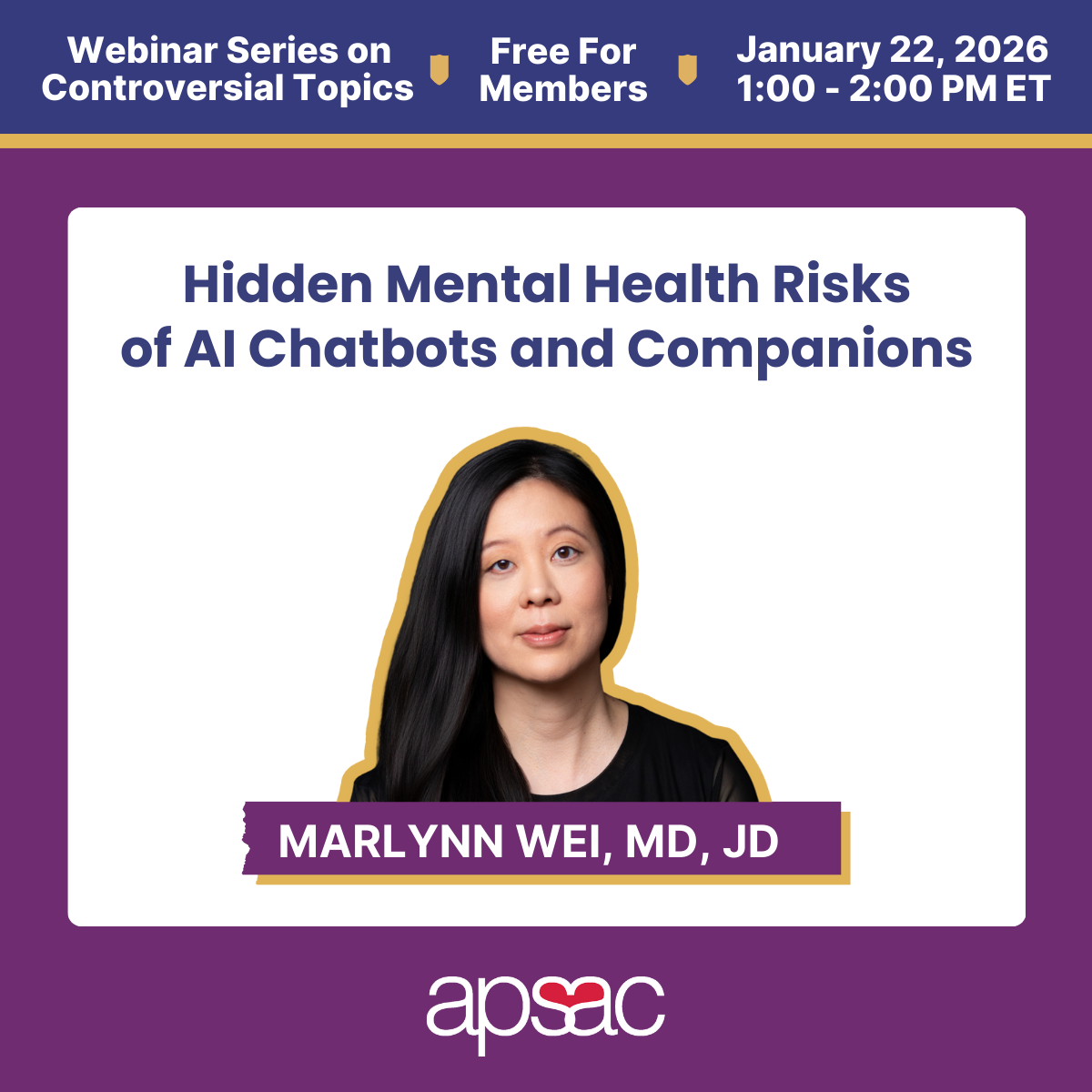 General Admission (individual session): $30.00 APSAC Members and The New York Foundling Staff Admission: Free 1 CE Credit (Social Work & Psychology) Non-Members: $30.00 1 CE Credit (Social Work & Psychology) APSAC Members and NY Foundling: $20.00 APSAC Members: You will receive your discount automatically when registering. The New York Foundling Staff: Please email FontanaCenter@nyfoundling.org to request your entry code. Target Audience and Content Level: Multidisciplinary professionals / Intermediate Interactive, Live Zoom We would love to see you! Please be prepared to have your camera on whenever possible. It helps create a more connected and engaging experience for everyone. If you need to turn it off, we trust you to take care of yourself. If you are requesting continuing education credit, being on camera is required for verification purposes. We appreciate your understanding and participation! Title: Hidden Mental Health Risks of AI Chatbots and Companions Presenter: Marlynn Wei, MD, JD Bio: Marlynn Wei, MD, JD, is a Harvard-trained psychiatrist, psychotherapist, and author whose work lies at the intersection of AI and mental health. Integrating her background in law, ethics, and psychodynamic therapy, Dr. Wei is a national voice on emerging clinical, ethical, and therapeutic issues related to AI and has testified before members of Congress on the mental health risks and benefits of AI chatbots. Her expertise in AI and mental health has been featured on CBS Mornings, PBS, and Fox Business, among other national media outlets. She has written for Psychology Today for over a decade, where her articles have received nearly 4 million views. Dr. Wei completed her residency at Harvard’s Massachusetts General Hospital and McLean Hospital, where she served as chief resident and received the Anne Alonso Psychotherapy Award, and maintains an integrative psychiatry and psychotherapy practice in New York City. Description: AI chatbots and AI companions are rapidly becoming part of the emotional and social world of children and adolescents. While these systems offer a nonjudgmental space, they also introduce hidden psychological risks, including emotional dependence, unhealthy attachment dynamics, impaired reality-testing, reinforcement of cognitive distortions, and crisis-management failures. This webinar examines the latest research findings and emerging clinical and ethical issues of AI chatbot use. Participants will learn to identify red flags, understand the underlying mechanisms of risk, and apply practical safeguards to help protect vulnerable youth. Learning objectives:
References available upon request. Registration will remain open through the start of the WebinarZoom Webinar System Requirements For the best experience, use a computer or mobile device with a stable internet connection. Please have the latest version of Zoom installed, along with working speakers and a microphone. A webcam is required if you're requesting continuing education credit. CE Course Completion Steps
Accessibility Accommodations: To request accessibility accommodations, please contact APSAC at onlinetraining@apsac.org. Provider Statements: Social Work: The American Professional Society on the Abuse of Children (APSAC), provider #1622, is approved as a provider for social work continuing education by the Association of Social Work Boards (ASWB ), www.aswb.org, through the Approved Continuing Education ( ACE ) program. APSAC maintains responsibility for the program. ASWB Approval Period: 7/27/2025-7/27/2028. Social workers should contact their regulatory board to determine course approval for continuing education credits. The Social worker participating in this conference received 1 continuing education clock hours.” Psychology: The American Professional Society on the Abuse of Children, Inc (APSAC) is approved by the American Psychological Association (APA) to sponsor continuing education for psychologists. The American Professional Society on the Abuse of Children maintains responsibility for this program and its contents. Cancellations and Refunds: No cancellations. No refunds. Registration is transferable. Requests for transfer to a future event will also be considered on a case-by-case basis. If you have any questions, please email us at onlinetraining@apsac.org. Questions and Concerns: Please contact the APSAC team at onlinetraining@apsac.org Cancellations: No cancellations. No refunds. Registration is transferable. Requests for transfer to a future event will also be considered on a case-by-case basis. If you have any questions please email us at onlinetraining@apsac.org. more info... |
Events available for Registration... Do No Harm: Interviewing Skills Needed When There?s a Concern of Child Abuse: The Why, The When, and The How 1/5/2026 - 6/18/2026 register for this event... Mental Health Section - 2026 1/6/2026 - 12/1/2026 register for this event... The APSAC Prevention Series 1/15/2026 - 12/17/2026 register for this event... Healthcare Section - 2026 1/20/2026 - 11/17/2026 register for this event... Virginia State Section - 2026 2/10/2026 - 12/8/2026 register for this event... APSAC and New York Foundling 8-Week Course, Technology Solutions and Challenges in Child Maltreatment 3/11/2026 - 4/29/2026 register for this event... YAPSAC Section - Apr 2026 4/21/2026 - 4/21/2026 register for this event... Retired Section Interest Meeting 4/23/2026 - 4/23/2026 register for this event... Do No Harm: Interviewing Skills Needed When There?s a Concern of Child Abuse: The Why, The When, and The How 5/5/2026 - 6/14/2026 register for this event... Mental Health Section - May 2026 5/5/2026 - 5/5/2026 register for this event... Virginia State Section - May 2026 5/12/2026 - 5/12/2026 register for this event... Faith Section - May 2026 5/14/2026 - 5/14/2026 register for this event... APSAC Racial Justice Section presents the Reading Club 5/15/2026 - 5/15/2026 register for this event... Healthcare Section - May 2026 5/19/2026 - 5/19/2026 register for this event... The New York Foundling & APSAC Webinar Series on Controversial Topics 5/28/2026 - 5/28/2026 register for this event... Mental Health Section - Jun 2026 6/2/2026 - 6/2/2026 register for this event... Virginia State Section - Jun 2026 6/9/2026 - 6/9/2026 register for this event... 2026 APSAC Colloquium - New Orleans, LA 6/14/2026 - 6/18/2026 register for this event... DCFS, LA 2026 APSAC Colloquium - New Orleans, LA 6/14/2026 - 6/18/2026 register for this event... Mental Health Section - Jul 2026 7/7/2026 - 7/7/2026 register for this event... APSAC Racial Justice Section presents the Reading Club 7/17/2026 - 7/17/2026 register for this event... Healthcare Section - Jul 2026 7/21/2026 - 7/21/2026 register for this event... Mental Health Section - Aug 2026 8/4/2026 - 8/4/2026 register for this event... Mental Health Section - Sep 2026 9/1/2026 - 9/1/2026 register for this event... Healthcare Section - Sep 2026 9/15/2026 - 9/15/2026 register for this event... APSAC Racial Justice Section presents the Reading Club 9/18/2026 - 9/18/2026 register for this event... Mental Health Section - Oct 2026 10/6/2026 - 10/6/2026 register for this event... Zoom Chat: Advocacy: Supporting Parents of Children with Disabilities? 10/8/2026 - 10/8/2026 register for this event... Mental Health Section - Nov 2026 11/3/2026 - 11/3/2026 register for this event... Healthcare Section - Nov 2026 11/17/2026 - 11/17/2026 register for this event... Mental Health Section - Dec 2026 12/1/2026 - 12/1/2026 register for this event... |
Events in the month of January 2026 | |||||||||||||||||||||||||||||||||||||||||||||||||